
Spoken English – Emotions
Who and What laid the foundations of Spoken English?
The person most commonly considered the **“Father of the English language”** is **Geoffrey Chaucer**.
—
# **Why is Geoffrey Chaucer called the Father of English?**
### **1. He wrote major literature in English when most writers used Latin or French**
During the 1300s, educated writing in England was mostly in:
* **Latin** (for scholars and the Church)
* **French** (used by the royal court)
Chaucer broke this tradition and chose to write in **Middle English**, making English a respected language for literature.
—
### **2. He shaped the development of Middle English**
Chaucer’s works, especially *The Canterbury Tales*, helped:
* Standardize grammar
* Spread new vocabulary
* Create a common literary style
His influence made English more recognizable and structured.
—
### **3. He made English a language of culture and storytelling**
Before Chaucer, English wasn’t seen as “prestigious.”
Chaucer’s writing:
* Reached ordinary people
* Showed English could be poetic and expressive
* Elevated English to a **literary language**
—
### **4. His works influenced later writers**
Chaucer inspired:
* Shakespeare
* Spenser
* Milton
* And many later English poets
His style shaped the future of English literature.
Geoffrey Chaucer is considered the Father of English because he used English for major literary works at a time when most wrote in Latin or French, helping to standardize and elevate the English language.
gillsir.com/english-as-dominant-language-of-the-world/
[caption id="attachment_11758" align="alignnone" width="1024"] history and timeline of english[/caption]
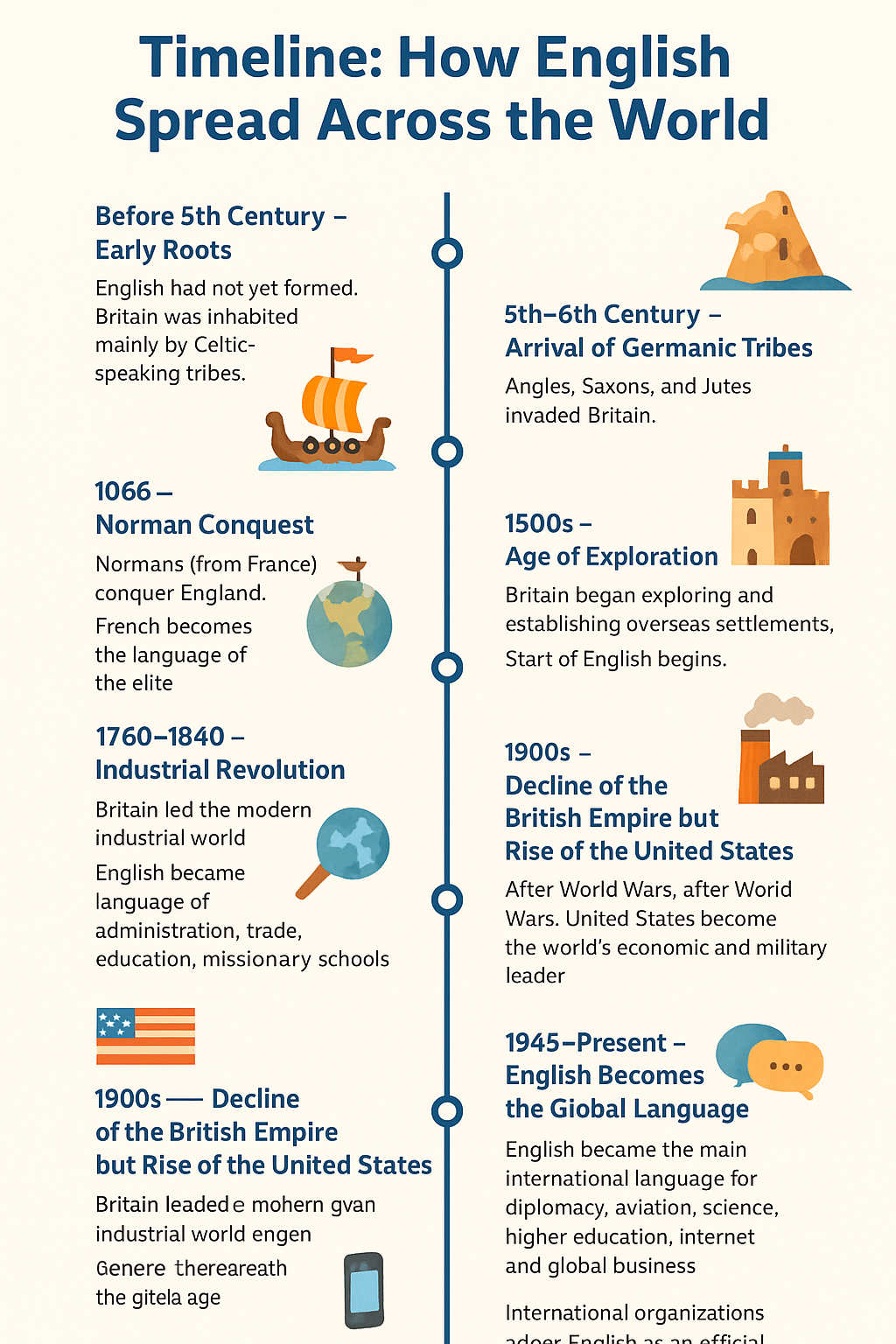 history and timeline of english[/caption]
English as dominant language in world and its timeline
English became dominant across the world due to a combination of **historical, political, economic, and cultural factors**, not because it is inherently better than any other language. Here are the main reasons: ### **1. British Colonization** * From the 1600s to the early 1900s, the **British Empire** expanded across Asia, Africa, North America, Australia, and the Caribbean. * Wherever the British ruled, they established English in government, education, law, and trade. * At its peak, the British Empire controlled about **25% of the world**, spreading English widely. ### **2. Industrial Revolution** * Britain led the **Industrial Revolution**, becoming a global center for science, technology, and trade. * Many innovations, research, and technical documents were produced in English, making it a language of progress. ### **3. Rise of the United States** * After World War II, the **USA became the world’s leading economic, military, and technological power**. * American influence in business, movies, music, aviation, computing, and the internet strengthened the global use of English. * Multinational companies (Google, Microsoft, Coca-Cola, etc.) operate largely in English. ### **4. Globalization and International Communication** * English became the **common language** for international trade, diplomacy, travel, science, and entertainment. * It is now the **official or working language** of the United Nations, NATO, the European Union, and global airlines. ### **5. Education and Opportunity** * People around the world study English because it opens doors to **jobs, higher education, migration, and global networking**. * English-language media—Hollywood movies, pop songs, social media—also make it more popular. ### **6. Internet and Technology** * A large portion of early internet content was in English. * Programming languages and tech documentation are mostly English-based, making it the “default” language of the digital age. --- English didn’t become dominant by chance—it spread through **colonial power (Britain), global influence (USA), technology, trade, and culture**. English Time Line --- ## **📘 Timeline: How English Spread Across the World** ### **1. Before 5th Century – Early Roots** * English had not yet formed. Britain was inhabited mainly by Celtic-speaking tribes. --- ### **2. 5th–6th Century – Arrival of Germanic Tribes** * **Angles, Saxons, and Jutes** invade Britain. * Their languages blend to form **Old English**, the earliest form of English. --- ### **3. 1066 – Norman Conquest** * The Normans (from France) conquer England. * French becomes the language of the elite; Old English mixes with Norman French. * This creates **Middle English**. --- ### **4. 1500s – Age of Exploration** * Britain begins exploring and establishing overseas settlements. * Start of English being carried abroad. * Transition into **Early Modern English** (Shakespeare’s time). --- ### **5. 1600s–1800s – British Empire Expands** * English spreads to **North America, Caribbean, Africa, Asia, and Australia**. * Becomes a language of: * Administration * Trade * Education * Missionary schools * “The sun never sets on the British Empire.” --- ### **6. 1760–1840 – Industrial Revolution** * Britain leads the modern industrial world. * English becomes the language of: * Science * Engineering * Manufacturing * Global trade --- ### **7. 1900s – Decline of the British Empire but Rise of the United States** * After World Wars, Britain’s power decreases. * The **United States becomes the world’s economic and military leader**. * American influence spreads English through: * Movies (Hollywood) * Music (pop, rock, jazz) * Technology * Business --- ### **8. 1945–Present – English Becomes the Global Language** * English becomes the **main international language** for: * Diplomacy * Aviation * Science * Higher education * Internet * Global business * International organizations (UN, NATO, EU) adopt English as an official language. --- ### **9. 1990s–Today – Digital Age** * Internet, software, smartphones, and AI grow mostly in English. * Most coding languages use English-based keywords. * English becomes the **default global communication tool**. --- From **Germanic origins** → **mixing with French** → **British colonial expansion** → **American influence and technology**, English gradually rose to become the world’s most widely learned language. ---
English as dominant language in world and its timeline
English became dominant across the world due to a combination of **historical, political, economic, and cultural factors**, not because it is inherently better than any other language. Here are the main reasons:
### **1. British Colonization**
* From the 1600s to the early 1900s, the **British Empire** expanded across Asia, Africa, North America, Australia, and the Caribbean.
* Wherever the British ruled, they established English in government, education, law, and trade.
* At its peak, the British Empire controlled about **25% of the world**, spreading English widely.
### **2. Industrial Revolution**
* Britain led the **Industrial Revolution**, becoming a global center for science, technology, and trade.
* Many innovations, research, and technical documents were produced in English, making it a language of progress.
### **3. Rise of the United States**
* After World War II, the **USA became the world’s leading economic, military, and technological power**.
* American influence in business, movies, music, aviation, computing, and the internet strengthened the global use of English.
* Multinational companies (Google, Microsoft, Coca-Cola, etc.) operate largely in English.
### **4. Globalization and International Communication**
* English became the **common language** for international trade, diplomacy, travel, science, and entertainment.
* It is now the **official or working language** of the United Nations, NATO, the European Union, and global airlines.
### **5. Education and Opportunity**
* People around the world study English because it opens doors to **jobs, higher education, migration, and global networking**.
* English-language media—Hollywood movies, pop songs, social media—also make it more popular.
### **6. Internet and Technology**
* A large portion of early internet content was in English.
* Programming languages and tech documentation are mostly English-based, making it the “default” language of the digital age.
—
English didn’t become dominant by chance—it spread through **colonial power (Britain), global influence (USA), technology, trade, and culture**.
English Time Line
—
## **📘 Timeline: How English Spread Across the World**
### **1. Before 5th Century – Early Roots**
* English had not yet formed. Britain was inhabited mainly by Celtic-speaking tribes.
—
### **2. 5th–6th Century – Arrival of Germanic Tribes**
* **Angles, Saxons, and Jutes** invade Britain.
* Their languages blend to form **Old English**, the earliest form of English.
—
### **3. 1066 – Norman Conquest**
* The Normans (from France) conquer England.
* French becomes the language of the elite; Old English mixes with Norman French.
* This creates **Middle English**.
—
### **4. 1500s – Age of Exploration**
* Britain begins exploring and establishing overseas settlements.
* Start of English being carried abroad.
* Transition into **Early Modern English** (Shakespeare’s time).
—
### **5. 1600s–1800s – British Empire Expands**
* English spreads to **North America, Caribbean, Africa, Asia, and Australia**.
* Becomes a language of:
* Administration
* Trade
* Education
* Missionary schools
* “The sun never sets on the British Empire.”
—
### **6. 1760–1840 – Industrial Revolution**
* Britain leads the modern industrial world.
* English becomes the language of:
* Science
* Engineering
* Manufacturing
* Global trade
—
### **7. 1900s – Decline of the British Empire but Rise of the United States**
* After World Wars, Britain’s power decreases.
* The **United States becomes the world’s economic and military leader**.
* American influence spreads English through:
* Movies (Hollywood)
* Music (pop, rock, jazz)
* Technology
* Business
—
### **8. 1945–Present – English Becomes the Global Language**
* English becomes the **main international language** for:
* Diplomacy
* Aviation
* Science
* Higher education
* Internet
* Global business
* International organizations (UN, NATO, EU) adopt English as an official language.
—
### **9. 1990s–Today – Digital Age**
* Internet, software, smartphones, and AI grow mostly in English.
* Most coding languages use English-based keywords.
* English becomes the **default global communication tool**.
—
From **Germanic origins** → **mixing with French** → **British colonial expansion** → **American influence and technology**, English gradually rose to become the world’s most widely learned language.
—