Some Students don’t get success in Spoken English.
There are many reasons why some students **don’t learn spoken English**, even when they want to. These reasons can be emotional, educational, social, or practical. Here are the most common ones:
—
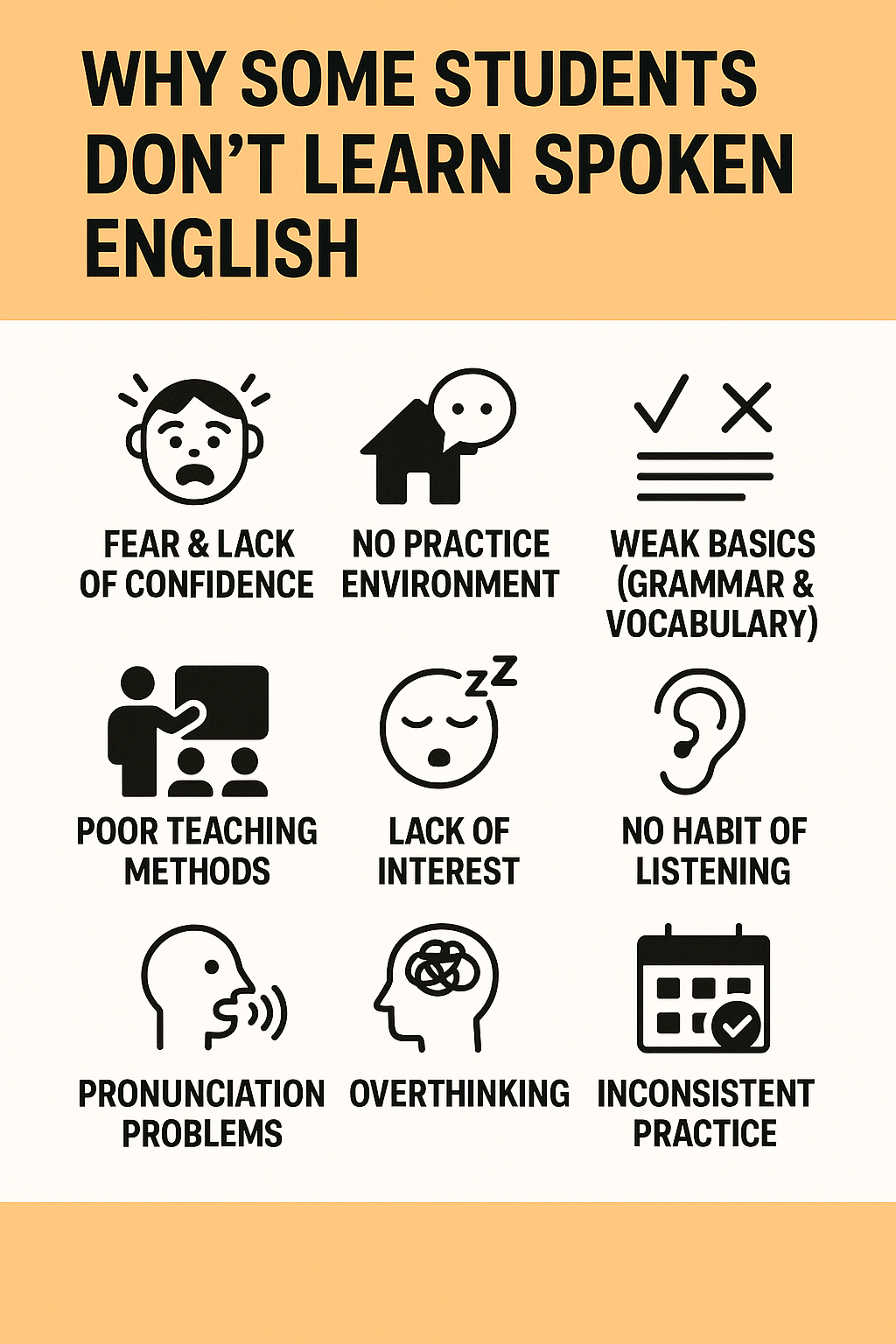
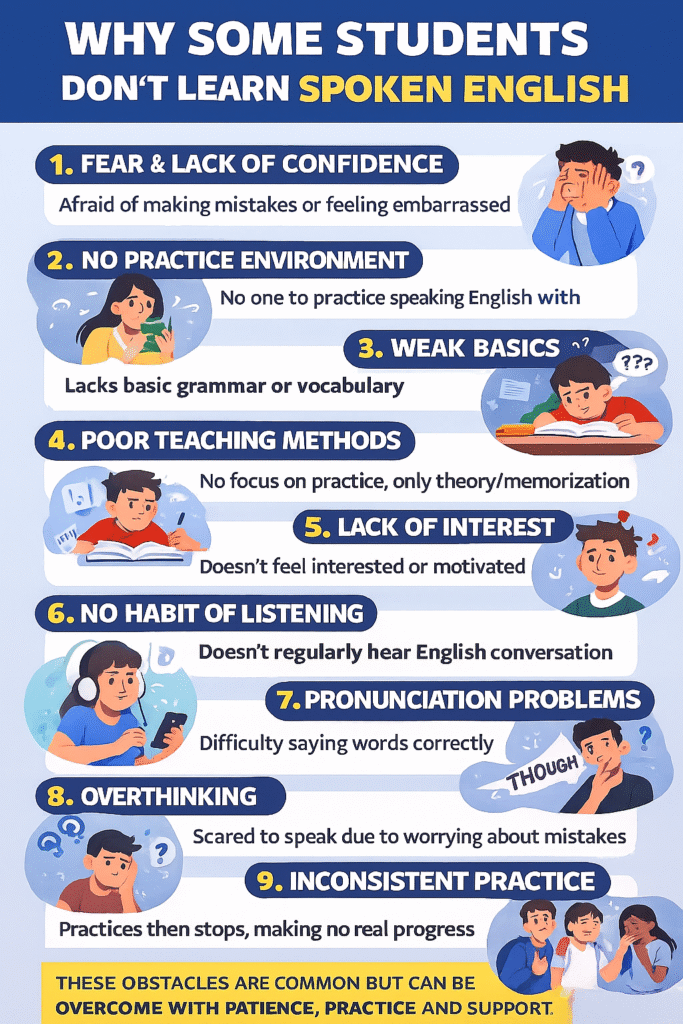
# **1. Fear & Lack of Confidence**
Many students hesitate because they:
* Fear making mistakes
* Feel shy or embarrassed
* Worry people will laugh at them
* Have low self-confidence
This fear becomes the biggest barrier to speaking.
—
# **2. No Practice Environment**
Spoken English requires **speaking**, but many students:
* Live in non-English-speaking surroundings
* Have no one to practice with
* Use their native language at home and school
Without practice, improvement becomes slow.
—
# **3. Weak Basics (Grammar & Vocabulary)**
Students struggle when they:
* Don’t know basic grammar
* Have limited vocabulary
* Can’t form sentences
* Mispronounce words
This makes them avoid speaking altogether.
—
# **4. Poor Teaching Methods**
Some teaching systems focus too much on:
* Theory
* Grammar
* Writing
* Memorization
and very little on **speaking**.
Because of this, students may know rules but cannot speak fluently.
—
# **5. Lack of Interest or Motivation**
Some students feel:
* English is difficult
* It’s not necessary for them
* They can survive without it
* Learning requires too much effort
Without motivation, progress stops.
—
# **6. No Habit of Listening**
Speaking improves through:
* Listening to English stories
* Movies
* Conversations
* Songs
* Podcasts
Students who don’t listen to English regularly struggle to develop fluency.
—
# **7. Pronunciation Problems**
If students cannot pronounce words correctly, they:
* Become nervous
* Avoid speaking
* Feel others won’t understand them
This reduces confidence.
—
# **8. Overthinking**
Students often think:
* “What if I make a mistake?”
* “What if people judge me?”
* “Is this sentence correct?”
Overthinking stops them from speaking naturally.
—
# **9. Inconsistent Practice**
Even motivated students fail when they:
* Practice for a few days
* Stop for a week
* Start again
* Leave again
Fluency needs **daily practice**, even if only 10–15 minutes.
—
# **10. Negative Environment**
If friends, teachers, or family:
* Make fun of them
* Don’t support English learning
* Discourage speaking
Students lose confidence and stop trying.
—
# **11. Learning for Exams, Not for Speaking**
Some students learn English only for:
* School exams
* Written tests
This gives knowledge but not speaking skill.
—
### **In short:**
Students don’t learn spoken English mainly because of **fear, lack of practice, weak basics, low confidence, and poor learning environment**.