* In this case, police in Mehsana (Gujarat) unearthed a large racket in which aspirants paid large sums — reportedly around ₹14 lakh each — to obtain high IELTS band‑score certificates without legitimately qualifying. ([The Times of India][1])
* As many as ~950 people from Gujarat were suspected of fraudulently securing high IELTS scores under this scheme in a single year. ([The Times of India][1])
* The scheme involved collusion between human smugglers, exam‑centre staff, and aspirants. Exam administrators reportedly turned off CCTV cameras during the exam, substitute candidates gave the test in place of the real aspirants, and fake certificates were issued. ([The Times of India][2])
* Because of this, the authorities booked 45 people (including coaching‑class owners, educational‑firm heads, supervisors, and students) under various charges (forgery, cheating, criminal conspiracy). ([The Times of India][3])
This scandal is massive in both scale (hundreds of people) and potential impact (fraudulent immigration, damage to institutions’ credibility). Many consider it the single biggest-known “IELTS scam.”
* A decade earlier, police arrested 10 people in Gujarat for issuing fake IELTS certificates. According to reports, the racket had issued around 110 fake certificates and collected between ₹4–5 crore. ([The Indian Express][4])
* The fraudsters created a dummy version of the IELTS portal, and issued fake certificates after charging candidates fees ranging from ₹50,000 to ₹5 lakh depending on financial status. ([The Indian Express][4])
* It was detected when a candidate’s application at a foreign university was rejected — his IELTS certificate was found to be fake. ([The Indian Express][4])
Though smaller in scale than the 2022 scandal, this older scam was significant for its audacity: faking official IELTS certificates using a dummy portal and orchestrating a black‑market trade.
* As early as the mid‑2000s, there were reports of “fake English competency certificates” being used by students from Asian countries to enroll in foreign universities. Fake or forged certificates (including IELTS) were reportedly sold on black markets. ([Times Higher Education (THE)][5])
* More recently (2025), a major exam‑paper leak racket was uncovered in Dhaka (Bangladesh), with arrests made after leaked IELTS papers were sold to students before the test — leading to fraudulent high scores. ([The Finance Today][6])
These underline that cheating and fraud around IELTS have been systemic and global, not limited to one country or decade.
—
## 🧮 Why the 2022 Gujarat Scam Often Ranks as “Greatest”
| Factor | What Made It Huge |
| ——————————– | ————————————————————————————————————————– |
| **Scale** | ~950 suspected fake‑score aspirants — far more than earlier scams. |
| **Monetary magnitude** | Each aspirant reportedly paid ~₹14 lakh; with hundreds involved, total money exchanged was high. |
| **Complex orchestration** | Involved human smugglers, exam‑centre insiders, substitute test‑takers, fake certificates, CCTV manipulation. |
| **Cross-border implications** | Affected immigration to US/Canada — some caught crossing border illegally; certificate misuse for visas/admissions abroad. |
| **Exposure and legal crackdown** | 45 people booked, including organizers, centre‑owners, staff — large‑scale investigation by police. |
Because of all these factors combined, many media and legal observers consider this the most consequential IELTS scam to date — effectively undermining the credibility of IELTS exam results for a large group.
—
## ⚠️ Broader Significance & What It Means for Students
* These scams hurt not just individuals, but the integrity of international education and immigration systems. When fraudulent results come to light (or are suspected), authorities in destination countries often tighten verification checks or distrust legitimate applicants.
* Aspirants who genuinely worked hard — especially from countries with high competition — are unfairly impacted, as overall trust in English‑proficiency certificates erodes.
* Legal consequences are serious: in Gujarat case, those involved were booked for forgery, cheating, criminal conspiracy — showing that it’s not a harmless scam, but a serious crime.
—
* [The Times of India](https://timesofindia.indiatimes.com/city/ahmedabad/ielts-scam-hc-directs-jmfc-court-to-decide-closure-report-afresh/articleshow/122671894.cms?utm_source=chatgpt.com)
[1]: https://timesofindia.indiatimes.com/city/ahmedabad/950-from-gujarat-used-fake-ielts-scores-to-move-to-us-canada/articleshow/93308617.cms?utm_source=chatgpt.com “Ielts: 950 From Gujarat Used Fake Ielts Scores To Move To Us, Canada | Ahmedabad News – Times of India”
[2]: https://timesofindia.indiatimes.com/city/ahmedabad/gujarat-45-booked-three-arrested-in-ielts-scam/articleshow/94014244.cms?utm_source=chatgpt.com “Ielts: Gujarat: 45 booked, three arrested in IELTS scam | Ahmedabad News – Times of India”
[3]: https://timesofindia.indiatimes.com/education/news/gujarat-cops-unearth-ielts-exam-racket-coaching-class-owner-education-firm-ceo-among-45-booked/articleshow/94015851.cms?utm_source=chatgpt.com “Gujarat cops unearth IELTS exam racket, coaching class owner, education firm CEO among 45 booked – Times of India”
[4]: https://indianexpress.com/article/cities/ahmedabad/fake-ielts-certificate-scam-exposed-10-held/?utm_source=chatgpt.com “Fake IELTS certificate scam exposed,10 held | Ahmedabad News – The Indian Express”
[5]: https://www.timeshighereducation.com/news/trade-in-fake-papers-soars/196461.article?utm_source=chatgpt.com “Trade in fake papers soars | Times Higher Education (THE)”
[6]: https://www.thefinancetoday.net/article/national/29400/Massive-IELTS-exam-paper-leak-racket-uncovered?utm_source=chatgpt.com “Massive IELTS exam paper leak racket uncovered | National | FT | The National Financial Portal”
Who and What laid the foundations of Spoken English?
The person most commonly considered the **“Father of the English language”** is **Geoffrey Chaucer**.
—
# **Why is Geoffrey Chaucer called the Father of English?**
### **1. He wrote major literature in English when most writers used Latin or French**
During the 1300s, educated writing in England was mostly in:
* **Latin** (for scholars and the Church)
* **French** (used by the royal court)
Chaucer broke this tradition and chose to write in **Middle English**, making English a respected language for literature.
—
### **2. He shaped the development of Middle English**
Chaucer’s works, especially *The Canterbury Tales*, helped:
* Standardize grammar
* Spread new vocabulary
* Create a common literary style
His influence made English more recognizable and structured.
—
### **3. He made English a language of culture and storytelling**
Before Chaucer, English wasn’t seen as “prestigious.”
Chaucer’s writing:
* Reached ordinary people
* Showed English could be poetic and expressive
* Elevated English to a **literary language**
—
### **4. His works influenced later writers**
Chaucer inspired:
* Shakespeare
* Spenser
* Milton
* And many later English poets
His style shaped the future of English literature.
Geoffrey Chaucer is considered the Father of English because he used English for major literary works at a time when most wrote in Latin or French, helping to standardize and elevate the English language.
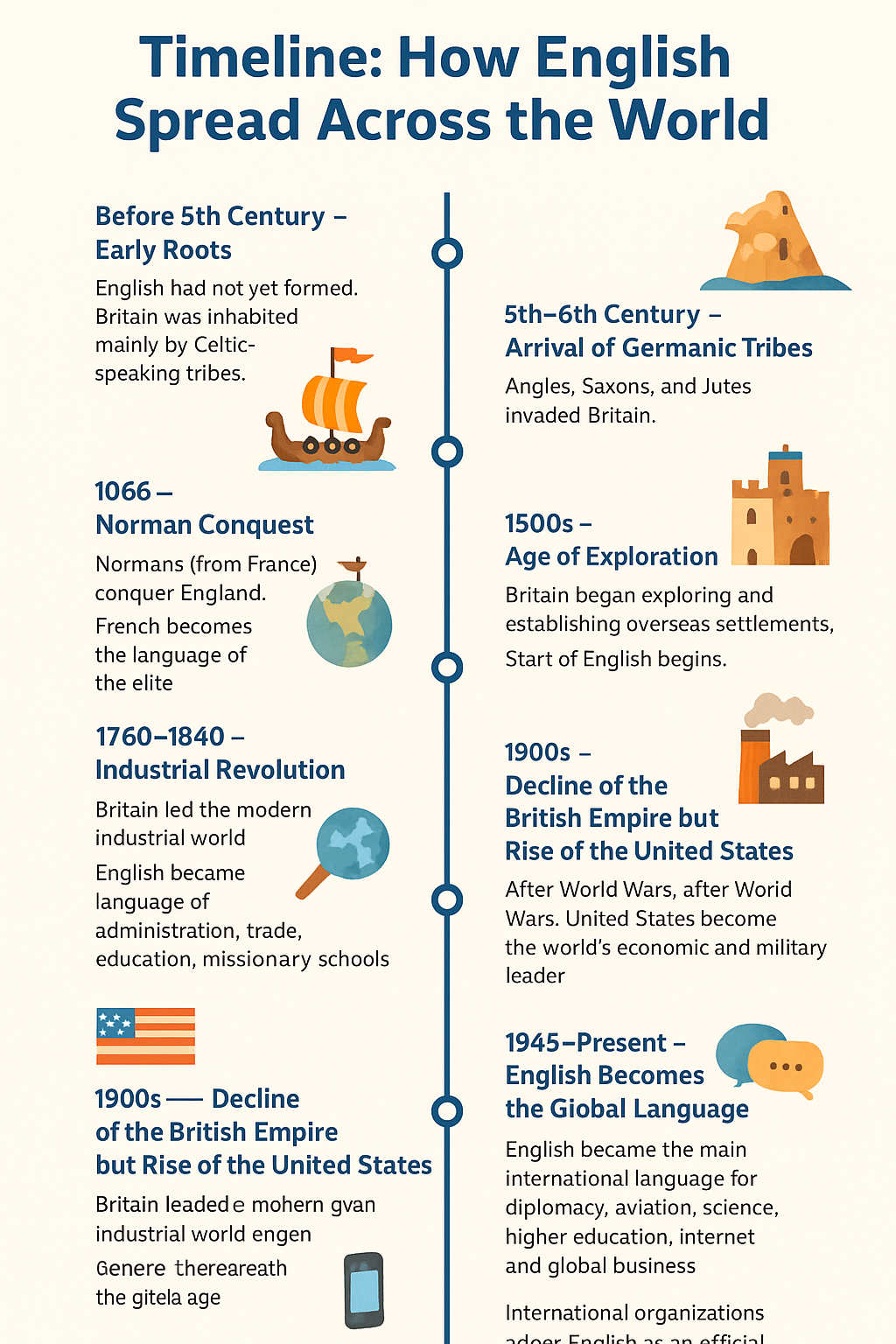
[caption id="attachment_11758" align="alignnone" width="1024"] history and timeline of english[/caption]
English as dominant language in world and its timeline
English became dominant across the world due to a combination of **historical, political, economic, and cultural factors**, not because it is inherently better than any other language. Here are the main reasons:
### **1. British Colonization**
* From the 1600s to the early 1900s, the **British Empire** expanded across Asia, Africa, North America, Australia, and the Caribbean.
* Wherever the British ruled, they established English in government, education, law, and trade.
* At its peak, the British Empire controlled about **25% of the world**, spreading English widely.
### **2. Industrial Revolution**
* Britain led the **Industrial Revolution**, becoming a global center for science, technology, and trade.
* Many innovations, research, and technical documents were produced in English, making it a language of progress.
### **3. Rise of the United States**
* After World War II, the **USA became the world’s leading economic, military, and technological power**.
* American influence in business, movies, music, aviation, computing, and the internet strengthened the global use of English.
* Multinational companies (Google, Microsoft, Coca-Cola, etc.) operate largely in English.
### **4. Globalization and International Communication**
* English became the **common language** for international trade, diplomacy, travel, science, and entertainment.
* It is now the **official or working language** of the United Nations, NATO, the European Union, and global airlines.
### **5. Education and Opportunity**
* People around the world study English because it opens doors to **jobs, higher education, migration, and global networking**.
* English-language media—Hollywood movies, pop songs, social media—also make it more popular.
### **6. Internet and Technology**
* A large portion of early internet content was in English.
* Programming languages and tech documentation are mostly English-based, making it the “default” language of the digital age.
---
English didn’t become dominant by chance—it spread through **colonial power (Britain), global influence (USA), technology, trade, and culture**.
English Time Line
---
## **📘 Timeline: How English Spread Across the World**
### **1. Before 5th Century – Early Roots**
* English had not yet formed. Britain was inhabited mainly by Celtic-speaking tribes.
---
### **2. 5th–6th Century – Arrival of Germanic Tribes**
* **Angles, Saxons, and Jutes** invade Britain.
* Their languages blend to form **Old English**, the earliest form of English.
---
### **3. 1066 – Norman Conquest**
* The Normans (from France) conquer England.
* French becomes the language of the elite; Old English mixes with Norman French.
* This creates **Middle English**.
---
### **4. 1500s – Age of Exploration**
* Britain begins exploring and establishing overseas settlements.
* Start of English being carried abroad.
* Transition into **Early Modern English** (Shakespeare’s time).
---
### **5. 1600s–1800s – British Empire Expands**
* English spreads to **North America, Caribbean, Africa, Asia, and Australia**.
* Becomes a language of:
* Administration
* Trade
* Education
* Missionary schools
* “The sun never sets on the British Empire.”
---
### **6. 1760–1840 – Industrial Revolution**
* Britain leads the modern industrial world.
* English becomes the language of:
* Science
* Engineering
* Manufacturing
* Global trade
---
### **7. 1900s – Decline of the British Empire but Rise of the United States**
* After World Wars, Britain’s power decreases.
* The **United States becomes the world’s economic and military leader**.
* American influence spreads English through:
* Movies (Hollywood)
* Music (pop, rock, jazz)
* Technology
* Business
---
### **8. 1945–Present – English Becomes the Global Language**
* English becomes the **main international language** for:
* Diplomacy
* Aviation
* Science
* Higher education
* Internet
* Global business
* International organizations (UN, NATO, EU) adopt English as an official language.
---
### **9. 1990s–Today – Digital Age**
* Internet, software, smartphones, and AI grow mostly in English.
* Most coding languages use English-based keywords.
* English becomes the **default global communication tool**.
---
From **Germanic origins** → **mixing with French** → **British colonial expansion** → **American influence and technology**, English gradually rose to become the world’s most widely learned language.
---
English as dominant language in world and its timeline
English became dominant across the world due to a combination of **historical, political, economic, and cultural factors**, not because it is inherently better than any other language. Here are the main reasons:
### **1. British Colonization**
* From the 1600s to the early 1900s, the **British Empire** expanded across Asia, Africa, North America, Australia, and the Caribbean.
* Wherever the British ruled, they established English in government, education, law, and trade.
* At its peak, the British Empire controlled about **25% of the world**, spreading English widely.
### **2. Industrial Revolution**
* Britain led the **Industrial Revolution**, becoming a global center for science, technology, and trade.
* Many innovations, research, and technical documents were produced in English, making it a language of progress.
### **3. Rise of the United States**
* After World War II, the **USA became the world’s leading economic, military, and technological power**.
* American influence in business, movies, music, aviation, computing, and the internet strengthened the global use of English.
* Multinational companies (Google, Microsoft, Coca-Cola, etc.) operate largely in English.
### **4. Globalization and International Communication**
* English became the **common language** for international trade, diplomacy, travel, science, and entertainment.
* It is now the **official or working language** of the United Nations, NATO, the European Union, and global airlines.
### **5. Education and Opportunity**
* People around the world study English because it opens doors to **jobs, higher education, migration, and global networking**.
* English-language media—Hollywood movies, pop songs, social media—also make it more popular.
### **6. Internet and Technology**
* A large portion of early internet content was in English.
* Programming languages and tech documentation are mostly English-based, making it the “default” language of the digital age.
—
English didn’t become dominant by chance—it spread through **colonial power (Britain), global influence (USA), technology, trade, and culture**.
English Time Line
—
## **📘 Timeline: How English Spread Across the World**
### **1. Before 5th Century – Early Roots**
* English had not yet formed. Britain was inhabited mainly by Celtic-speaking tribes.
—
### **2. 5th–6th Century – Arrival of Germanic Tribes**
* **Angles, Saxons, and Jutes** invade Britain.
* Their languages blend to form **Old English**, the earliest form of English.
—
### **3. 1066 – Norman Conquest**
* The Normans (from France) conquer England.
* French becomes the language of the elite; Old English mixes with Norman French.
* This creates **Middle English**.
—
### **4. 1500s – Age of Exploration**
* Britain begins exploring and establishing overseas settlements.
* Start of English being carried abroad.
* Transition into **Early Modern English** (Shakespeare’s time).
—
### **5. 1600s–1800s – British Empire Expands**
* English spreads to **North America, Caribbean, Africa, Asia, and Australia**.
* Becomes a language of:
* Administration
* Trade
* Education
* Missionary schools
* “The sun never sets on the British Empire.”
—
### **6. 1760–1840 – Industrial Revolution**
* Britain leads the modern industrial world.
* English becomes the language of:
* Science
* Engineering
* Manufacturing
* Global trade
—
### **7. 1900s – Decline of the British Empire but Rise of the United States**
* After World Wars, Britain’s power decreases.
* The **United States becomes the world’s economic and military leader**.
* American influence spreads English through:
* Movies (Hollywood)
* Music (pop, rock, jazz)
* Technology
* Business
—
### **8. 1945–Present – English Becomes the Global Language**
* English becomes the **main international language** for:
* Diplomacy
* Aviation
* Science
* Higher education
* Internet
* Global business
* International organizations (UN, NATO, EU) adopt English as an official language.
—
### **9. 1990s–Today – Digital Age**
* Internet, software, smartphones, and AI grow mostly in English.
* Most coding languages use English-based keywords.
* English becomes the **default global communication tool**.
—
From **Germanic origins** → **mixing with French** → **British colonial expansion** → **American influence and technology**, English gradually rose to become the world’s most widely learned language.
In many ways, English and one’s mother tongue (or native language) *can* compete in people’s lives, especially in a globalized world where English is often seen as the dominant language for business, technology, education, and even entertainment. This competition can create both opportunities and challenges, depending on the context and the individual’s situation.
### **How English and Mother Tongue Might Compete:**
1. **Language Shift and Identity:**
* In many communities, there’s a shift toward using English in daily life, sometimes at the expense of the mother tongue. This can lead to a gradual loss of native languages, especially in younger generations who may be more exposed to English through school, media, or the internet.
* When children learn English as their second language, they may begin to prioritize it, often because it feels more “global” or “useful” for career opportunities. This can sometimes lead to the diminishing importance of the mother tongue, especially if it’s not being actively spoken at home or in the community.
* On the flip side, for some people, their native language is a key part of their identity, culture, and sense of belonging. Losing or neglecting their mother tongue could feel like losing a connection to their heritage and family history.
2. **Bilingualism and Cognitive Load:**
* On a practical level, speaking both English and a mother tongue (especially in bilingual or multilingual societies) means constantly switching between languages. This “code-switching” can be mentally demanding, especially in fast-paced conversations or academic settings.
* Some people feel that they must choose one language for certain contexts (e.g., speaking English at work and the mother tongue at home) which can create a kind of internal conflict or pressure to “perform” in both languages.
3. **Language Learning and Skill Development:**
* Learning English can be seen as an economic advantage in many parts of the world, as it’s the language of international business, science, and technology. As a result, many students spend a lot of time learning English, sometimes at the expense of developing strong skills in their native language.
* In some cases, this can lead to “English dominance,” where people become fluent in English but lose proficiency in their first language over time, especially if English is used predominantly in school, work, or digital spaces.
4. **Social and Cultural Expectations:**
* In some societies, speaking English well is often associated with status, intelligence, or modernity. This can make individuals feel like they need to prioritize English, even if it comes at the cost of their cultural language.
* There can also be social pressure to “fit in” by adopting English in social media, education, or professional settings. This creates a situation where the mother tongue may be relegated to more informal or private spaces (like home or among close friends), while English takes precedence in public life.
### **Balancing Both Languages:**
While English and a mother tongue can sometimes “compete” for space in people’s lives, it’s possible to strike a balance between the two:
* **Language Preservation:** Many people actively work to preserve their mother tongue by teaching it to their children, using it in daily conversations, or even engaging in cultural activities that promote its use.
* **Bilingual Education:** In many parts of the world, bilingual education programs are designed to help students maintain fluency in both languages. This allows them to participate in global opportunities while also staying connected to their roots.
* **Cultural Celebrations:** In a world where English is dominant in the media, people often turn to music, literature, traditions, and festivals in their native language to keep it alive. This reinforces the importance of the mother tongue as a cultural asset, not just a means of communication.
### **English as a Global Connector:**
It’s also worth noting that English, while seen as a “global” language, is not necessarily replacing mother tongues everywhere. In fact, it often serves as a bridge language that enables people from different linguistic backgrounds to communicate with each other. Many people are multilingual, using English in one context (e.g., work or travel) and their mother tongue in another (e.g., at home or in their local community).
So, in a sense, English and a mother tongue don’t have to be in competition; they can coexist in ways that enrich a person’s life. The challenge is ensuring that both languages are valued and nurtured, rather than one being overshadowed by the other.
The term **”spoken English”** doesn’t have a single inventor or creator, as it’s more of a natural evolution of the Englishlanguage itself. However, the **concept** of spoken English as distinct from written English has evolved over time, largely influenced by linguistic development and the historical spread of English.
### Here’s a brief historical breakdown:
1. **Origins of English**: English itself originated from a mixture of Anglo-Saxon (Old English), Norman French, Latin, and other European languages, beginning in the early medieval period (around 5th to 12th centuries). In those early times, **spoken English** was the primary form of communication, as literacy rates were low and books were rare.
2. **The Rise of Literacy**: Written English started becoming more formalized in the 14th and 15th centuries, particularly with the spread of the **printing press** in the 15th century (thanks to Johannes Gutenberg). This is when written English began to be standardized, and distinctions between spoken and written forms of the language started to become more apparent.
3. **The Evolution of Spoken vs. Written Language**: By the 16th and 17th centuries, scholars and grammarians like **William Shakespeare** and **Samuel Johnson** were refining written English, which led to a divergence between spoken and written language forms. Spoken English was more flexible, informal, and regional, whereas written English became more standardized and structured, particularly in formal contexts.
### The Term Itself:
* **Spoken English** as a specific term likely became common as educational systems around the world began to formalize the teaching of English in the 19th and 20th centuries, particularly as English spread globally due to colonization and trade. The term was used to distinguish between the **spoken** and **written** forms of the language.
* It is difficult to pinpoint exactly when the term was first used, but it’s likely a natural progression of language development and teaching.
### Notable Figures in Language Development:
* **Noam Chomsky**, a 20th-century linguist, contributed significantly to the study of language, including spoken language, with his theories on grammar and syntax, though his focus was more on language structure rather than the specific term “spoken English.”
* **Henry Sweet**, an English philologist in the 19th century, was important in the study of phonetics (the sounds of spoken language) and was a key figure in the development of the understanding of spoken language.
In short, while **spoken English** as a term didn’t have a single inventor, the distinction between spoken and written English became clearer as the language evolved over centuries. The spread of English worldwide and the formalization of education likely contributed to the widespread use of the term.
If you are looking for the best spoken English classes in Maninagar, Gill Sir offers expert coaching to help you develop strong communication skills. Whether you are a beginner or aiming for advanced fluency, our courses are designed to enhance your English proficiency for academic, professional, and everyday conversations.
Basic English vs. TOEFL English – What’s the Difference?
Basic English:
Focus: Everyday language, simple vocabulary, and fundamental grammar.
Purpose: Helps in daily communication and understanding common instructions.
Examples: “Hello,” “Thank you,” “Where is the market?”
TOEFL English:
Focus: Academic English with advanced vocabulary, complex grammar, and structured writing.
Purpose: Assesses English proficiency for higher education in English-speaking countries.
The guardian news speaks of Modi government calling Englishlanguage colonial relic; because it feels that Bharitya people should come out of the trap of a mentality that is not going to help us.
Modi, it seems have taken the idea of Sri Aurobindo when he constantly says that we should come out of the colonial mindset. Sri Aurobindo Ashram has been publishing and publicizing the fact that colonial mindset has been detrimental of India in many ways.


 history and timeline of english[/caption]
