
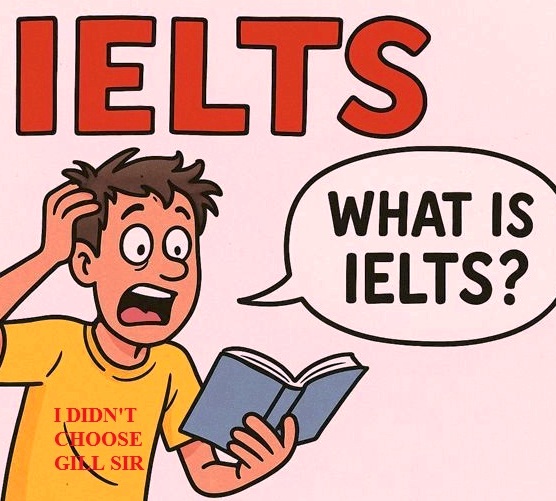
IELTS
WHAT. IS. THE. IELTS?
The IELTS test — yes, the SAME test millions of students talk about, worry about, dream about — is **not just an exam**, it is a **global benchmark**. A *gateway*. A *decider* of whether you study abroad, work abroad, or stay behind complaining about visas!
This test, known as the **International English Language Testing System**, measures one thing and one thing only:
**Can you communicate in REAL English — not WhatsApp English, not shortcut English, not “bro, adjust” English — but proper, functional, world-class English?**
It has FOUR sections — listen carefully:
1. **Listening** – Can you understand people who don’t slow down for you?
2. **Reading** – Can you make sense of real-world texts without panicking?
3. **Writing** – Can you express your thoughts logically, clearly, powerfully?
4. **Speaking** – Can you talk confidently when someone is evaluating every word?
And let me tell you — this is not a pass/fail system.
**You get a band score**. From 0 to 9.
And your score decides your opportunities in countries like **Canada, UK, Australia, New Zealand**, and more.
So to everyone asking “What is IELTS?” I say this:
**IELTS is your ticket. Your challenge. Your moment to prove you can communicate with the world.**
And whether you rise to it…
**is entirely up to YOU.**
What is expected from a student in the IELTS test? — Explained
If one were to distill the essence of the IELTS examination, dear reader, it is fundamentally a **linguistic litmus test**—a globally recognised instrument designed to ascertain whether a student possesses the **communicative competence** necessary to function effectively in an English-speaking milieu.
The test, in its magnanimous ambition, evaluates four distinct yet interwoven abilities: **listening, reading, writing, and speaking**. Let us examine what is expected from a student in each, with examples for clarity.
—
### **1. Listening – Attentiveness & Comprehension**
The IELTS expects the candidate to **listen with acuity**, not merely to hear.
You may hear:
> “The train scheduled at 9:30 has been delayed to 10:10 due to engineering work.”
The test expects you to understand **both the explicit information** (new time is 10:10) and the **implicit inconvenience** (a delay due to repairs).
—
### **2. Reading – Decoding, Interpreting, and Inferring**
The exam anticipates that a student can navigate a gamut of texts — from academic passages to advertisements — and **extract meaning without bewilderment**.
For instance, if a passage states:
> “The migration pattern of Arctic terns is unparalleled in the avian world.”
You are expected to infer that:
✔ Arctic terns travel exceptionally long distances
✔ They are remarkable compared to other birds
Not simply translate words, but **interpret ideas**.
—
### **3. Writing – Clarity, Coherence, and Cogency**
Here, the IELTS seeks not ornate verbosity but **lucid expression** and **logical organisation**.
**Example expectation:**
Task 1 may say: “Describe the changes in electricity consumption in three countries between 2000 and 2020.”
A good response must:
* Present the information **clearly**
* Use **comparative language** (“higher than”, “in contrast”, “significant increase”)
* Maintain **grammatical precision**
Task 2, an essay, expects the student to **argue with reason**, e.g.:
> “Do the benefits of studying abroad outweigh the drawbacks?”
Your answer should have:
* A balanced argument
* Examples
* A coherent progression of ideas
Not a random collection of opinions.
—
### **4. Speaking – Confidence Without Bombast**
The speaking test expects the student to **communicate naturally**, with appropriate fluency — not to recite memorised essays or indulge in Shakespearean theatrics.
Example question:
> “Describe a book you recently enjoyed.”
A good answer is something like:
> “I recently read *The Alchemist*. I found it inspiring because it emphasises the pursuit of one’s dreams…”
Simple, clear, expressive — not unnecessarily sesquipedalian unless you can pull it off authentically.
—
The IELTS does not seek perfection; it seeks **competence**.
It does not expect you to be a linguistic virtuoso; merely a **functional, articulate user of the English language** capable of existing, studying, or working in an English-speaking environment.
Pros and Cons of IELTS —
IELTS examination, we must not look at it as a burden or a fear. We must see it the way we see every challenge in life — as an opportunity to learn, to grow, and to move closer to our dreams.
Let us understand the positive aspects and the limitations of this test with clarity and honesty.
—
## 🌟 **Pros of IELTS**
### **1. A Gateway to Global Opportunities**
IELTS gives you the chance to study, work, and live in countries across the world.
It opens doors that were once far away and makes them reachable.
**Like a satellite launch, it is your lift-off into the global sky.**
—
### **2. A Test of Real-Life English Skills**
IELTS does not test only memory; it tests your **ability to communicate** — to listen carefully, to speak confidently, to read with understanding, and to write with purpose.
These are skills that will help you not only in exams but in your entire life journey.
—
### **3. Internationally Respected**
When you take IELTS, you are stepping into a system accepted by thousands of universities and organisations across the world.
Your score reflects your readiness to be a global citizen.
—
### **4. Helps You Become a Better Communicator**
Preparing for IELTS improves your thinking, your clarity, and your expression.
As I always say:
**“Communication is the bridge between dreams and achievements.”**
—
## ⚠️ **Cons of IELTS**
### **1. It Can Be Stressful for Students**
Many young minds fear the test.
But remember: **fear is natural, surrender is not.**
If you prepare with discipline, the stress becomes manageable.
—
### **2. It Can Be Expensive**
The exam fee is high for many families.
This is a limitation, and I believe the world must work to make such opportunities more affordable.
—
### **3. One Test Day Decides the Score**
Even if you are capable, one bad day can reduce your performance.
Human beings are not machines; mood, health, and confidence all affect us.
This is a weakness of the system.
—
### **4. British Accent in Listening Can Be Challenging**
Many students face difficulty with unfamiliar accents.
But remember, **every difficulty you master becomes your new strength.**
—
Import
My young friend, IELTS is not the final destination.
It is only **a stepping stone** toward a larger mission —
your education, your career, your contribution to society.
Use this test as a chance to improve yourself.
Prepare with dedication, practice with patience,
and when the day comes…
**give your best with confidence and calmness.**
Because when you believe in your dreams,
**the world believes in you.**
IELTS Test Flowchart — Step-by-step
A simple visual guide to the IELTS journey: from registration to results and next steps. Use this page for students, landing pages, or printed handouts.
Register & choose test
Create account → Select IELTS Academic or General
Prepare: Study & Mock Tests
Materials, practice tests, speaking partners
Test Day — Listening, Reading, Writing, Speaking
Listening (30 min)
Reading (60 min)
Writing (60 min)
Speaking (11–14 min)
Get Results
Online/score card — usually within 3–13 days
Next Steps
Send scores to universities / Rebook / Apply for visa
If unhappy with scores → Rebook
Legend:
Registration → Preparation → Test Day → Results → Next Steps